Goodbye Elementor: When Your Most Loyal Teacher Walks Out, The River Has Already Burst
On 16 October 2026, Rino de Boer uploaded a 24-minute video called "Goodbye Elementor. I'm moving on." If you have built a WordPress site in the last six years and got stuck on a transparent header, a loop grid or a container that refused to behave, there is a decent chance Rino got you out of it. He has made Elementor tutorials for seven years, sold around 1,500 copies of an Elementor Pro course, survived a burnout or three and an office that literally burned down. He is not a drive-by hater. He is the sort of person a software company should build a statue of.
And he has just walked out of the building, politely, explaining exactly why. The video passed 138,000 views in under two weeks. That is not a creator having a sulk. That is a eulogy with a comments section.
Full credit where it belongs: Rino's video is measured, fair, and full of caveats like "these are not facts, they're just theories". We are under no such obligation. Let's go through what he said, then do what he was too decent to do.
The man who sold the dream
Rino's origin story is the page builder origin story. Design school, Photoshop mockups handed to a developer, a ThemeForest theme bent into shape, endless back-and-forth. Then page builders arrived and a designer could sell the whole job. Elementor was, in his words, "revolutionary". It genuinely was. It turned a generation of designers into website businesses.
Then Covid locked everyone indoors in front of YouTube, and his channel exploded. He is honest about that too: "I just thought like, 'Wow, my videos are so great.'" Part skill, part wave. The same is true of Elementor itself. A lot of its 18-million-site glory was a pandemic sugar rush and a market with no better option.
The two-year promise that took three years
The heart of Rino's complaint is not AI. It is a promise. In April 2023 Elementor announced a proper classes and variables system, the thing that separated it from Webflow and Bricks. Rino stayed loyal precisely because of it. He did not want to learn a new builder and retrain his clients. Elementor was going to catch up, wasn't it?
“And then two years of silence almost. They didn't really say much about it.”
Rino's theory is that Elementor tried to bolt classes onto the V3 editor, discovered it couldn't, and quietly decided to rebuild the entire thing as the Atomic Editor, without admitting the first attempt had failed. The timeline he lays out is brutal on its own: announcement April 2023, "rolling out soon" January 2025, a far-from-ready alpha April 2025, a beta in February 2026 that still wasn't ready, then a proud V4 launch in April 2026 that was still not done, with V3 widgets offering features V4 didn't have.
“It feels like an upgrade and a downgrade at the same time. It almost felt like the paying customers were the guinea pigs.”
He is specific that he doesn't mean bugs. He means features released half-built, repeatedly. Meanwhile the editor, running V3 and V4 widgets side by side, got slower, crashed constantly, mangled CSS, and occasionally took minutes to load. If you charge an annual subscription, "wait a few minutes for the editor" is not a quirk. It is a refund request with extra steps.
Why is a 400-person company slower than a team of six?
Rino asks the question every Elementor professional has asked in a Facebook group at 1am: why does a company with three or four hundred staff move so much slower than Bricks or Oxygen, built by far smaller teams with more features? He offers theories, and they are good ones:
- →Backward-compatibility worship. Elementor bends over backwards to keep every old site working. Divi took the brutal route and told users to update within a year. Elementor chose to carry every ancestor on its back.
- →Side projects. Hosting, an email product, Site Planner, the AI bundle, Sticklight. Some had value. Collectively, they diluted focus.
- →Too many management layers. The classic scale-up disease: more meetings, fewer merges.
- →Investors over users. Rino is careful here, but he names Angie specifically, suggesting the MCP could have shipped five or six months earlier if the company had listened to its own talent instead of chasing the money-shaped feature.
We'll be less careful. These theories are not alternatives. They are the same disease. A venture-backed company that raised money on 'the website builder for everyone' has to show growth to people who have never opened the editor. Growth comes from new products and new subscriptions, not from finishing the classes system you promised in 2023. So you get Elementor One, Angie, Sticklight and a hosting upsell, while the core editor crashes on a Tuesday. The incentives built exactly the company Rino is describing.
Elementor is not a website builder. It never was.
This is the most important line in the video, and Rino arrived at it by learning AI, not by reading competitor marketing:
“Elementor is just a front-end builder. They call themselves the website builder. That's how they wanna position themselves, but it's not. Without WordPress and the theme system, Elementor cannot function at all.”
Once you understand the stack, server, database, CMS, front end, you realise Elementor owns the one layer that AI is now best at generating. Server and database are boring and stable. The CMS is WordPress. The front end, the bit Elementor charges you for, is precisely what Claude, Lovable and friends produce in seconds, in clean HTML, without a 300KB DOM tax.
Rino's read is that Elementor saw this coming, which is why it rebranded as a professional agency tool: AI would eat the bottom of the market, so retreat upmarket. The problem is that professionals demand professional features, and Elementor can't deliver them while stuck between a half-finished V4 and a V3 nobody can retire. The beginners are upset because it isn't simple any more. The pros are upset because it isn't professional enough. Congratulations: you have built a product for nobody, at scale.
The creator economy has already voted
Rino is refreshingly honest about money. Elementor content used to be popular on YouTube. It isn't now. Algorithm changes, people asking AI instead of watching tutorials, and people wanting to learn AI rather than page building. Affiliate sales are down because fewer people buy WordPress products. Sponsorships are down. AdSense is down because views are down. A high-quality tutorial still eats three or four days of his week.
Pay attention to this, because creators are the canary in the plugin mine. They earn on attention and commissions, so they feel demand fall months before a company's quarterly figures admit it. When the people paid to promote your product can no longer afford to promote it, the market has given its verdict. Rino even says that if he were perfectly happy with Elementor he still couldn't keep making the videos. The love is gone and so is the money. That's a divorce, not a break.
What Rino does now (and why it should terrify Elementor)
His new workflow is the most damning part, because it isn't an anti-WordPress rant. He is staying on WordPress. He is only dropping the builder:
- →Design directly in HTML with Claude. No Figma either.
- →Host the HTML designs with a feedback plugin so clients comment on the real thing, Figma-style.
- →Convert the HTML into a clean WordPress theme, with his own CSS framework loaded via a Claude skill.
- →Give clients Pencil, his own click-to-edit plugin, for text and images. Layout changes come back to him.
- →Use Bricks, a one-time purchase, only when a complex project or a client genuinely demands a builder.
- →Build web apps inside WordPress with Claude via an MCP connector.
He points out that skipping the builder is cheaper in AI credits, because the model doesn't need to understand how Elementor wants its data, and the results are faster and visually unrestricted: 3D, shaders, things page builders simply can't do. And he has proof: a 10K website sold on this workflow, with a happy client.
Then he puts the knife in, gently:
“You really think your client is gonna mess around with your classes and your variables? They can't even figure out containers.”
That is the entire Elementor value proposition for the end client, 'you can edit it yourself', dismantled by its most famous teacher. The professional features made it too complex for clients. The clients only ever needed to change text and pictures. Pencil does that. The middle of the sandwich, the expensive bit, is no longer required.
His channel is rebranding from LivingWithPixels to LivingWithPrompts. The name change says everything: the age of pushing pixels around a canvas by hand is over, according to someone who was very, very good at it.
The geopolitics nobody in the plugin directory wants to discuss
Rino mentions it in one sentence, kindly: the staff were doing their best, and "it doesn't help that they were trying to run a company from a city that is in war with another country". Elementor is headquartered in Ramat Gan, Israel. That is a fact, not a political statement, and it has commercial consequences any honest analysis has to address.
- →Operational disruption. Since October 2023, Israeli tech companies have dealt with reserve call-ups pulling engineers out for months, rocket alerts, shelter time and the plain human toll of working through a war. Nobody ships a classes system well from a bomb shelter. That isn't a criticism of the people. It's arithmetic.
- →Concentration risk. A product running on roughly 18 million sites has its core engineering, leadership and decision-making concentrated in one region with an elevated risk profile. Enterprise and agency procurement teams increasingly ask about vendor continuity. 'Our builder is in an active conflict zone' is not a box anyone enjoys ticking.
- →Customer sentiment. Like it or not, some customers and agencies, particularly in parts of Europe, the Middle East and Asia, now factor a vendor's country into buying decisions. Consumer boycott movements have targeted Israeli tech. You can find that fair or deeply unfair; a SaaS business with global subscribers still has to price it in.
- →Talent and capital. Israel's tech sector has kept raising money, but investors have grown more cautious, and some companies have moved staff or functions abroad. A company that laid off around a third of its workforce in June 2026 has less slack to absorb any of this.
None of this is Elementor's fault in a moral sense, and none of it makes the people there less capable. But markets don't run on moral sense. They run on perceived risk, and right now Elementor carries a stack of it that Bricks (Germany), Breakdance and Oxygen (US) and an AI coding agent (anywhere) simply don't.
Angie, the MCP, and the art of sandbagging a river
Now to the 'New Elementor'. In the last year the company has unleashed a flood of shiny things: V4 Atomic Editor, Elementor One, Angie the in-platform AI agent, the separate Elementor MCP module (still in beta, and not part of Angie), third-party MCP adapters like WPVibe and Novamira cheering from the sidelines, and Sticklight, the off-platform AI builder that doesn't use Elementor at all.
Look at that list honestly and ask what problem each one solves. Angie lets you prompt your way around an editor that is too complicated to click your way around. The MCP lets Claude or Lovable drive the editor so you don't have to. Sticklight lets you skip the editor entirely. Every one of these products is an admission that the editor itself is the problem.
As we argued in our piece on Elementor MCP adapters, using frontier AI to operate Elementor is like using a state-of-the-art robotic arm to type on a 1950s typewriter. Rino's video is the field report: the person best qualified to use the robotic arm has looked at the typewriter and decided to write in plain text instead. When your expert teacher says the AI is better used without your product, your AI features are not a moat. They are sandbags.
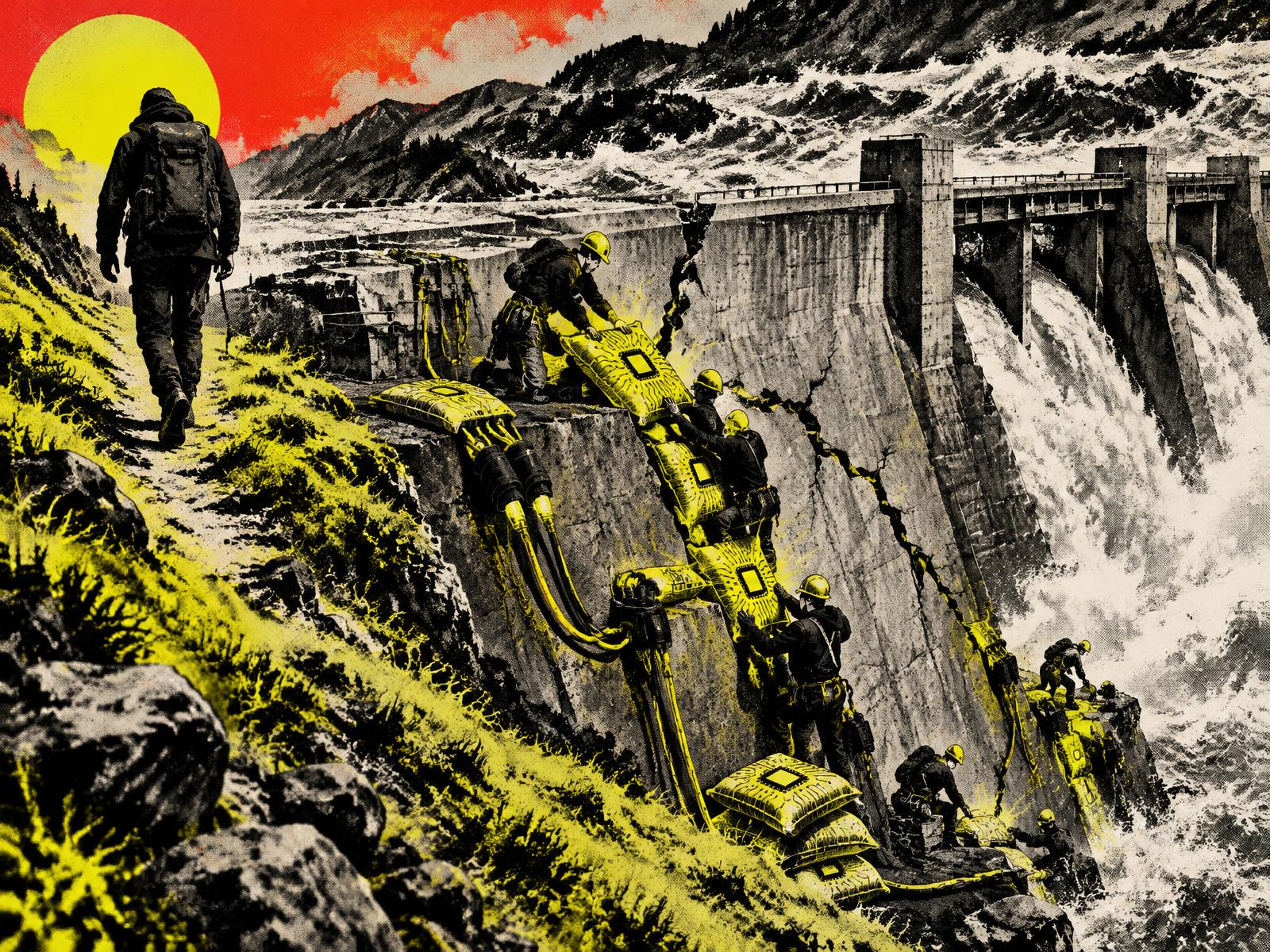
And sandbags work, for a while. They buy time. They keep the existing install base, the agencies with 200 client sites and annual renewals, inside the walls for another cycle or two. That is a perfectly rational business strategy. It is just not a growth strategy. You do not sandbag a river because you expect it to flow backwards. You sandbag it because you are hoping it rains less next year.
So what happens to Elementor?
Speculation, clearly labelled. Here is how we read the next few years:
- →Short term (6 to 12 months): the install base holds, because migrating hundreds of client sites is miserable. Renewals continue on inertia. Expect more AI announcements, more bundling into Elementor One, and the V4 gaps slowly closing. Expect more creators to follow Rino quietly, without the courtesy of a 24-minute explanation.
- →Medium term (1 to 3 years): new builds stop starting on Elementor. Agencies keep maintaining old sites but begin new ones in clean themes, Bricks, or off WordPress altogether. The install count becomes a measure of legacy, not momentum, in exactly the way the 43% WordPress figure already is.
- →Long term: Elementor becomes a maintenance business with an AI front-end, monetising an ageing install base through hosting and bundles, or it bets the company on Sticklight and competes head-on with Lovable, Bolt, Wix and everyone else in a market it doesn't lead. A sale to a larger hosting or private-equity group, the traditional retirement home for mature WordPress assets, is a very plausible ending.
What doesn't happen is a triumphant comeback where everyone rediscovers the joy of nested containers. The flow of the river is clear. Rino didn't leave because Elementor got worse, although in places it did. He left because he no longer needs it.
The bit Elementor should actually listen to
The cruellest thing about Rino's video is how loyal it is. He waited three years for a promised feature. He taught V4 when it disappointed him. He kept making videos when the money dried up. He still won't fully trash the company and is careful to credit employees who were doing their best.
Companies lose haters all the time and nothing happens. When you lose your most patient, most generous, most famous advocate, and he leaves with a polite explanation and a better workflow, something has already happened. You just haven't seen it in the renewal numbers yet.
Go and watch the video. It's the most honest thing written about Elementor this year, and it was written by someone who loved it.
Found this useful? Argue with it.
More Heresies →